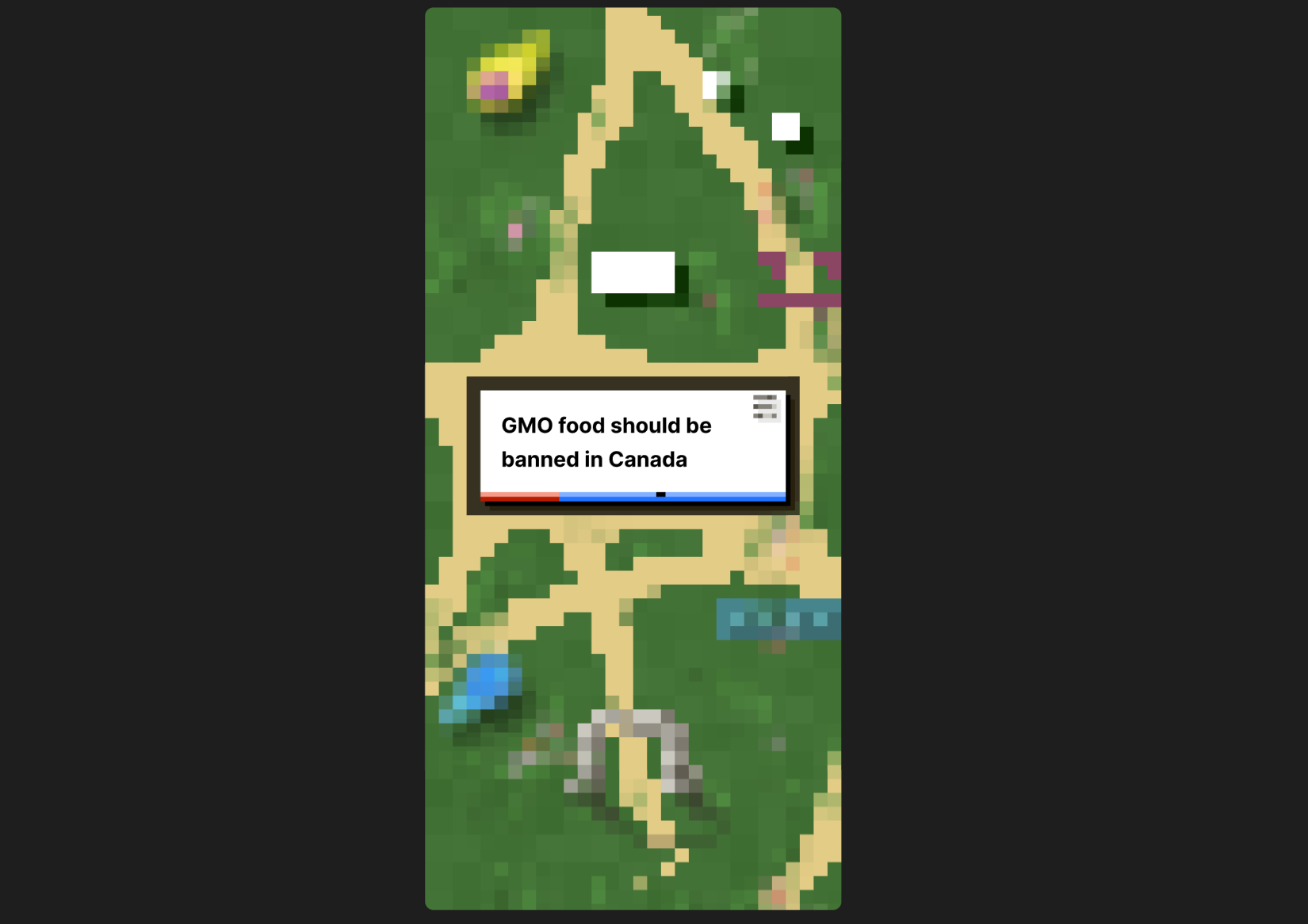
Would it be desirable for claims to have “mesas” — little “2D landscapes” that surround them — in which users could draw, post images and audio, and interact with each other in real-time via chat and perhaps voice? Each claim could sit in the center of its mesa with paths leading off to portals which, when passed through, take the user to the mesas of related claims.
Drawing
It’s tempting to allow everyone to draw but I’m afraid that things could get a little wild if it was unrestricted. You could:
- Only let users draw in certain areas. For example, there could be a radius around the original claim in which you cannot paint. As you go farther out, the opacity of your paint could start to increase.
- Only give users a limited amount of paint. They could acquire it by doing something in the system like writing claims, offering feedback of various kinds, etc.
- You could have paint boards that appear like little icons on the main landscape. You approach them and get a preview, and then you have to click to open them in full. Maybe, different users could have different permissions on their paint boards so that certain things are ungriefable.
- Paint boards could actually be like overlays where you do get to paint on the landscape but you can only view the paint when you’ve interacted with the board. So it’s like painting on an overlay. A single landscape could have many different overlays created by different users.
- Maybe some parts of certain overlays could be actually instantiated on the landscape.
- Allow users to interact with the landscape in more limited ways. For example, they could plant flowers which then grow. They could place small items that are premade like stones, fences, bushes, and other things. If they’re creative and they collect enough stones, they could draw with them.
- Users could design their own items. Items could be shared between claims. This could give each region of the graph a consistent yet distinct local flavour. There could be local “artisans” who produce the items that give each area its distinctive designs.
Portals
Portals connect local claim spaces. They could look like pools of water with stone pillars in the middle or like stone archways.
- Maybe there should be a region around portals where users are allowed to draw.
Transitions through portals
As you approach portals, the tiles from the other side could begin replacing your claim’s tiles on the opposite side of the portal from you. It’s almost like a carpet into the other world is unfurled for you. Then as you step onto the boundary, the rest of the world on that side of the portal is painted in but you can still see your world painted on your side. As you continue, your world gets reduced to just the region immediately on the original side of the portal and then eventually disappears completely as you move off into the new world.
Misc. ideas
- Could be good to try make the skane as relevant as possible to the actual meaning. I mean, to make it so that it’s not just a random art board attached to a claim but like, that there are ways where the meaning of the claim and the relations can be influenced by what you do in the board.
- Maybe drawings you make in the board can become visible from the main claim or something like that. That could work — there’s a constellation of things arranged spatially around the claim in the skein but some are visible from the main UI too.
- Landscapes should probably be sparse and grayscale near the portal so that they wouldn’t be off-putting. But beyond as you move farther out, perhaps out past the portals, larger gray shrubs and trees start to appear. Then perhaps colour. The landscapes could be procedurally generated.
- The mesa should probably be tiled — go in any direction for long enough and you end up back at the center. It just means there doesn’t have to be an arbitrary edge.
- There are parallels to the forest between worlds with all the pools.
Names
- The Mesa
- The Slate
- The Bedrock
- The Skein
Original notes
In keeping with the importance of non-corporate graphic design, it could be quite powerful to design the claim graph as some kind of public whiteboard and art space. It’s been a looming problem that visual media is missing from Wicker — almost certainly a fatal flaw according to the standards of the internet of the late 2020s. It also seems likely that the way we think and communicate cannot be separated from our more “human” sides; that memes and art are essential to our public discourse. It has always been clear that Wicker must not be seen as “only for intellectuals”; it cannot be too clean or corporate. The mess of humanity must be embraced. I was thinking about how the claim graph might look and was liking the idea that it might be a dark space with glittering, pixelated stars showing you where you are.
Then I started thinking about the old blog idea which would have a simulated ecosystem playing out in the background of a single page that was a landscape with blog posts embedded in various places to be discovered, all arranged according to their subject. I started thinking about Minecraft and the art on public servers. I started thinking about the importance of being able to cultivate your own little spaces; your own niches and communities with your own artistic sensibilities and expressions.
These things somehow fit together. There is spatial memory and the creation of spaces according to meaning. There is the fact that the graph is already of somewhat dubious value (and could potentially benefit from some feature that makes it more attractive). There’s the fact that Wicker needs something to differentiate it — something that a traditional social platform would never do. To have Wicker be a space that’s as much oriented around collaborative art and creativity as it is around collaborative reasoning could be exactly what is needed. You could even imagine including public musical “instruments” of some kind. Little drum machines or synthesizers, perhaps, that people could program and which would broadcast to anyone who was nearby. Inherent in all this is the idea of the graph as a landscape or a space that can be navigated. Users would have a location in this space. It would be designed as something that could be “inhabited” and shaped in creative ways. The content of the graph itself may be less important in this space since, in general, I think text-based navigation is more likely to be useful for the rational aspects.